What We Lost in the Water
Video installation
2022—2025

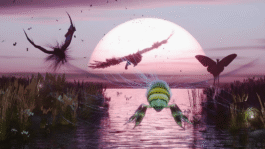
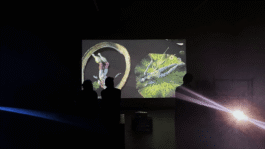
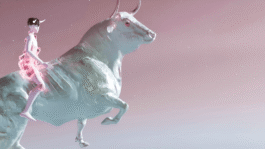
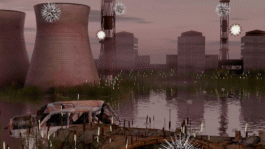
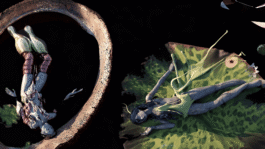
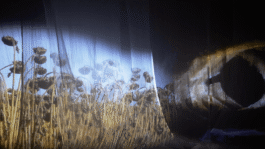
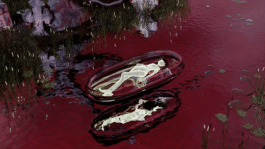
Video installation. 2022—2025 ⁄ Stills from What We Lost in the Water video
What We Lost in the Water explores the so-called Plan for the Great Transformation of Nature, one of the largest-scale attempts to permanently change the climate for human benefit. The erection of hydrological infrastructure was followed by flooding of 2155 km² of fertile soil, villages and forests, dam destruction under Nazi occupation, and the ecocide of late capitalism.
The plan for the reengineering of nature forever altered the land, rivers, and thousands of lives across Ukraine, Uzbekistan, and Kazakhstan. What We Lost in the Water emerges from my family archive – fading photographs, letters, fragments of fabric passed down from my grandmother. These remnants of domestic life expose how systems of power reorganise space through forced labour, memory, and ritual. The work follows the need to inhabit absence – to engage with what has been rendered ghostlike.
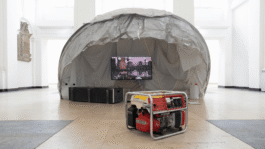
The video installation is set within a silver survival dome. It draws from the speculative biotechnospheres of Ukrainian artist and technofuturist Fedir Tetyanych, also known as Fripulia. Already in 70s Tetyanych envisioned self-sustaining capsules for life after collapse. The prototype of this structure is shaped by imaginaries of destroyed infrastructure and toxic survival. As a manifestation of partisan autonomy, the biotechnosphere seeks to rewire the connection between body, landscape, and technology.
The video follows the spirit of a protagonist who drowned during the flooding of the Great Meadow (Ukr. Velykyi Luh) – a once-thriving wetland ecosystem sacrificed to totalitarian hydropower. The ghost is doomed to wander through ruined landscapes, haunted by the threat of nuclear catastrophe.
To cultivate cotton – a strategic raw material for gunpowder and the military – the Soviet regime forcibly relocated over 20,000 families from Uzbekistan to Ukraine, climatically unsuitable for this crop. Massive irrigation canals transformed the Dnipro and Amu Darya into engines of extraction, with catastrophic consequences. In Central Asia, this initiative culminated in the disappearance of the Aral Sea. In Ukraine, the unique natural area of Velykyi Luh was annihilated.
During World War II, German occupational authorities exploited Ukrainian cotton fields, and both Soviet and Nazi armies destroyed the Dnipro dam in retreat – twice weaponizing the river to flood the land, kill civilians, and obliterate infrastructure.


In 2023, just a month after this work’s video-essay was released, Russian forces blew up the Kakhovka HPP dam, committing a massive act of ecocide. Meanwhile, in a new imperial cycle, migrant workers from Central Asia in Russia are being conscripted into Moscow’s army.
What We Lost in the Water traces the transformations of the Kherson Cotton Mill – a flagship Soviet factory inaugurated in 1953, just weeks after the death of Joseph Stalin. Built as a monument to postwar industrial supremacy, the mill later became a shopping mall, an entertainment complex, a bomb shelter, and finally a military base. Attacked repeatedly during the full-scale Russian invasion, it now lies in ruins.
As the project developed, more and more people got involved – artists, engineers, researchers who brought their own experiences and skills. The work turned into a collective endeavour, shaped by shared conversations, ideas, and time spent together. One of the most valuable parts of the process has been exactly that: working together, learning from each other, and making new friendships that outlived this journey. After all, the real treasure is the friends we make along the way.
https://vimeo.com/1088946375?share=copy
Password: water!
Director, producer, script, camera, 3D animation & environment:Daria Syvakos
CGI supervision, 3D animation & environment:Oleksii Voitikh
3D animation & environment:Daria Maiier
Characters design:Annkatrin Kluss
Editing, 3D animation & environment: Arvina Afsharnejad
Voice:Lucy Zorya
Script and story consultant: Wren Bisley
Video mixed media, 3D animation, filmed footage, sound
Installation 550 × 550 cm, fabric, rubber, polyvinyl, debris of destructed infrostructures, water bottles, electricity generator, wooden box;
sound, video loop, 17 min